Tuesday, 22 February 2011

Reading Strategies, Reading Comprehension, and Nouns! So much Learning...

What a busy day at Mema! In the morning, Form 2 girls applied the before, during, and after reading strategies that they have been learning about, to a short piece of realistic fiction about working in a newsroom. We began class with a quick review of the strategies where students excitedly came up to the board to write the strategies. The students love coming up to write on the chalkboard and their handwriting is always better than mine! Here are the strategies that students have been putting into action…


Students did such a fantastic job participating and speaking up (students here speak so softly that I can hardly hear them), so I promised to teach them a new game…we played a few rounds of hangman. Students had so much fun. I never thought that hangman could be so challenging until we played a few rounds using words in Swahili! The students took it easy on me though, and they didn’t add to the hangman picture whenever I took a turn guessing letters…

Mary calls on one of her classmates to guess a letter. 
Her word was shule which is Swhaili for school.

Later that morning, Form 3 girls started work on our class newsletter. They were excited to approach reading comprehension from a different angle. We talked about how in order to understand what we read we need to understand the way we write. We talked about the order of events, using details or examples to support key ideas or arguments, and as well as finding a purpose to write. Students were allowed to select a partner to work with as well as the topic they wanted to write about. The class agreed that the purpose for their writing would be to inform so many selected topics such as school, market day, and athletics to tell others who had never been to Kenya or Mema about this amazing place. At the end of each writing piece, students had to create two reading comprehension questions that a reader could answer based on what they read.

I am going to type each writing piece and add each set of partners picture to it as well as their questions. In the end it will be a very informative newsletter that can also be used to teach reading comprehension to other students instead of relying on the silly textbook all the time (which we are all so sick of).

Here are the girls working together to create an article about the national flag.

Later that afternoon, Form 1 boys practiced some grammar. I was shocked to see nearly 10 more boys had joined my class since last week, bringing our total to nearly 50 freshman boys. The more the merrier!

We have been learning all about nouns! The boys showed off what smarty-pants they are as we reviewed the different types of nouns and they were able to explain what a common noun, a proper noun, an abstract noun, and a concrete noun is. Today we furthered our discussion on nouns as we talked about the articles a, an, and the, that often come before a noun. The boys were able to explain why a and an are indefinite articles and the is a definite article. We also learned that we use the article a before nouns that begin with a consonant letter and we use the article an before nouns that begin with a vowel letter.

To make learning about articles fun, I handed out blank index cards and presented the boys with a challenge. I asked them to work in pairs and select a noun and the correct article (a or an) to go before it. They had to describe their noun using similes and their five senses. They had to create similes for how their noun looked, felt, smelled, sounded, and tasted. Although some nouns could not be smelled or tasted, we quickly learned that we were going to need a few more clues to figure out some of the nouns so we added clues to help. We had a great time trying to guess each others nouns, even though we didn’t even get through half the class.

Two of my Form One boys busy collaborating on what noun they are going to choose.

Here is an example of one, can you guess what noun this is?…

Sight- As big as a house.
Sound- As loud as a trumpet.
Touch- As rough as leather.
Smell- As smelly as a zoo.

Clue one: You can find me in a zoo or on a safari.
Clue two: I have two large tusks.
Clue three: I am a very large grey animal.

I am an elephant!

This activity was not as easy as it looks or sounds but students did a great job working through it and learning about nouns and articles!

Monday, 21 February 2011

Chickens...and Goats..and Cows! Oh, My!


What an exciting day of learning at Mema Secondary School! Today, Form 2 boys spent the morning learning about indefinite pronouns. We began our grammar lesson by defining and understanding exactly, what on earth, an indefinite pronoun is. We defined indefinite pronouns as: a pronoun which does not refer to a definite number of things or people. We listed as many indefinite pronouns as we could think of on the board, including: everyone, most, nobody, somebody, all, few, neither, both, plenty, anyone, someone, nobody, etc. After discussing and taking notes on singular and plural indefinite pronouns, we looked back at our list and organized our indefinite pronouns into the two categories.

I was a little worried that my class of forty boys were ready to fall asleep after creating sentences using the list, so I introduced to them a mini-project to recapture their interest and creativity while showing me that they could apply indefinite pronouns to their writing. The mini-project was an art and grammar opportunity. Students were told that they must select a product or a service that they wanted to sell. They were to create an add or a brochure for their business to entice people to buy their product or service. There were no limits on their creativity; however, they had to use at least six indefinite pronoun phrases in their ad. After I had finished the general description of the project I realized that the confused looks on their faces were not going away. So before I could go into anymore detail, I asked them if they had ever seen a tv commercial, a brochure advertising a place, or a newspaper ad selling a product. Only two students raised their hand. When I asked them to raise their hands if they had never seen an ad or a brochure nearly ever student in the class raised their hand. After almost 15 minutes explaining what an ad was, we were ready to begin our brochures.

I walked the boys step-by-step through creating their brochures, even showing them how to fold the paper I had to purchased for this lesson, into three columns so that it opened like a real brochure. I told students to come up with a catchy business name and then I told them that the company name, a slogan, and a picture of the product or service had to go on the cover, followed by the product or service description on the first inside flap. The remaining flaps had to contain six phrases (including two singular indefinite pronouns, two plural indefinite pronouns, and two of types of indefinite pronouns of their choice) that refered to their business, in order to pursuade people to buy what they were selling.

After making sure that the directions were clear, I handed out colored pencils for them to begin work. I was shocked to see that students were still looking at me confused. I asked them what was wrong. A student raised his hand and explained that they have only done work in their exercise books (notebooks) and that they were not sure what I wanted them to do. I explained that I wanted them to take the remaining 45 minutes to work on creating a brochure fin class. There was lots of looking around and laughing before students got down to work. Five minutes later, students were busy writing and designing their brochure. They were even raising their hands to ask questions and to have me look at their work. Students genuinely looked like they were enjoying the activity!

Despite how foreign this activity was to them, the brochures I saw were very creative and fun. Students were hard at work selling their chickens, goats, and cows, as well as, t-shirts, cars, and sausages. Students were having fun, laughing, being creative, and doing an outstanding job at applying indefinite pronouns. Here were a few of the phrases that some students used in their brochures: “Everybody is welcome to buy their chickens from Archer’s Chicken Farm!”, “Plenty of people buy their cars from Motors for You, Inc. Come get yours today!”, and “Nobody is unhappy when they get their eggs from Egg Sellers Coop.” It is amazing what these students can do when given the opportunity to step outside the box in applying what they have learned!

Friday, 18 February 2011

Pictionary and charades as an educational tool?

It is always great to visit different schools here to see how they are the same or different from the other schools in Kenya and the United States. Today I got the opportunity to teach a few lessons at Robondo Primary School. I was excited to be working with elementary students today, since I have spent most of my time here in Kenya working in a secondary school. Another added bonus was that it was only a short fifteen-minute walk compared to the forty minutes to Mema.

I showed up just in time to see all the students outside at an assembly. Every Friday students listen to the preacher give a sermon.
So many students!

I was asked to stand up and give a few words of encouragement... 

Talk about being put on the spot!

I was able to teach English to Class 7 and Class 8. To practice verbs and nouns I taught the students how to play Pictionary and charades. We learned that a noun was a person, place, thing or idea and that there are common nouns and proper nouns, as well as concrete and abstract nouns. After understanding the definition of what a noun is, it was time for a little fun. The class was divided into two teams (who were reluctant to select team names so we ended up calling them team one and team two). Each team selected an artist and I explained the rules to the class. I told the artists what noun to draw and they quickly got to work drawing as their teams guessed the noun they were drawing. The first round was very quiet but after that the students really got into it. We ended the game with a tie.

Our two fantastic drawers for team one and team two!

Laughter erupted as Otieno tried to draw a star! 
He asked if I could give them a different noun. 
It turns out he is a fantastic drawer of trees.

Next we learned about verbs. We discussed how verbs are action words. To reinforce this concept we played charades. I explained to students that they had to act out different movements or activities as the rest of the class tried to guess what verb it was. We only had two students come up and act out running and walking. This is a big step for these students because they hardly ever get up out of their seats and they never act silly in class. I was very impressed! Students really got into the next game as they practiced their verbs. I had the students pair up and one student had to be the mime and the other student had to be the mirror. The mirrors job was to “mirror” the action of the mime. Students were looking confused and it turns out they didn’t know what a mime was. I tried to compare it to a clown but they didn’t know what that was either. After explaining and acting a few things out myself (with lots of laughing and giggling from the students), and having two students demonstrate, I had students spread out in the room and begin acting out verbs silently—except for all the giggling and laughing going on.

I am explaining to two girls how to play the game, The Mirror and the Mime. 
The girls did an excellent job teaching the rest of the class.

I am not sure what verb this mime is pretending to act out and I think his mirror is also unsure...

It's always so rewarding to see so many smiles as students are learning!

In class 8, we worked on poetry as well as grammar. After introducing myself to the class, I explained that I wanted to get to know each one of them. To do this, we made bio-poems. I put the outline of the bio-poem on the board and gave students paper and colored pencils to fill in the spaces and add some decoration around their poem. After they filled out the bio-poem and then we went through and identified all the nouns, pro-nouns, verbs, and adjectives. 

One thing that I am learning working with students in Kenya is that it is very important to give clear directions for anything, even if it seems simple.  It is also very important to model what you want students to do. It took a bit, but before long students were busy filling in their own bio-poem. 


Students worked to fill out their bio-poems.

All in all, it was a very productive day at Robondo Primary School. I was never so pleased to see students afraid to raise their hands and who barely talk above a whisper, dancing around the room acting silly, as well as getting creative in their poetry!

Tuesday, 8 February 2011

Team Teaching!

As wonderful as it is to be teaching, I really love any opportunity to invite in other individuals to the class to share their knowledge. I feel that students really benefit from team teaching and guest speakers. Students interests are captured because it is someone new, and the guest teacher can offer different views and perspectives to the class.

Today, Diana, another volunteer at the home, came to class with me to team teach. Diana has many more years of experience teaching than me, so not only were the students learning but I was also learning by watching the teaching strategies and techniques that Diana used. Although, not currently teaching, Diana once taught at the university level.
Diana in the school courtyard! 

I began our lesson with the Form 3 girls, reviewing our reading strategies. Students eagerly came up to the board to fill in and explain how to use our before, during, and after reading strategies. We then practiced those strategies as we read a piece of short fiction that covered the topic of dilemmas. We discussed what dilemmas were as well as specific examples of dilemmas that we have experienced.

Students are very familiar with our reading strategies since we talk about them every class.
A student summarizes a paragraph. I have drilled my students in the importance of summarizing. 
If they can summarize it shows that they were able to comprehend.

Students listening as we discuss the topic of dilemma.

Next, Diana shared an article from The Standard, a Kenyan Newspaper, about child trafficking. Diana then asked students to infer from the paper the dilemmas that the people faced who were talked about in the article. Students were able to apply what they had learned from the lesson to the newspaper. This was also a great opportunity for students to see directly how the strategies they were using applied to real life as well as the information and topics they were learning about!

Here is Diana as she shares the article with the class.

Wednesday, 2 February 2011

Adventures in Kipsing!

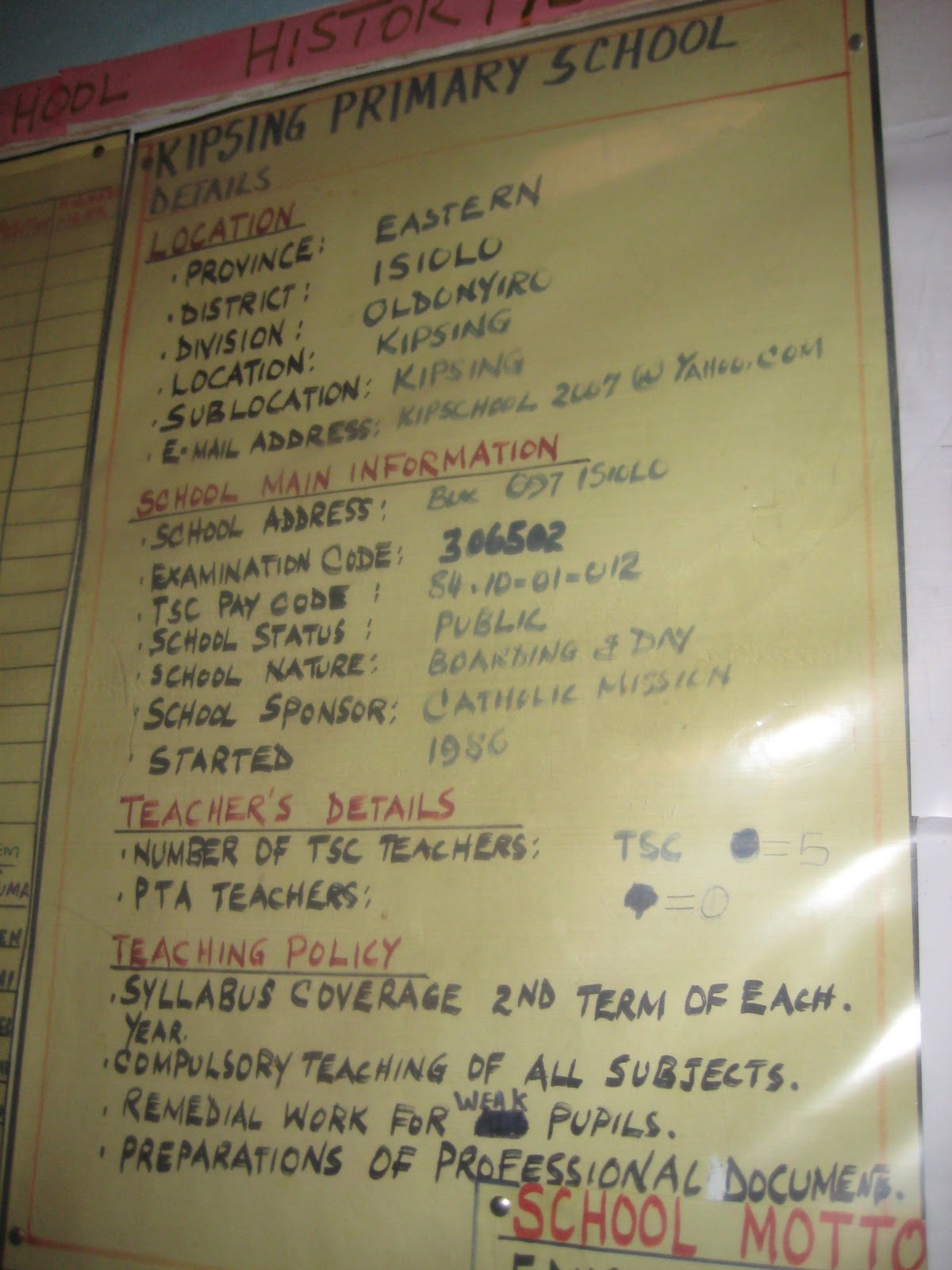
What a very busy and adventurous week in Kipsing. Kipsing is a small community of Samburu pastoralists. It is nearly a three hour drive from the main road, along a bumpy and worn dirt road. The family of Josaphine, a young Samburu who we were working with on a girls project, warmly welcomed us. Josaphine, is dedicated to saving young Samburu girls from early forced marriages, a traditional Samburu practice that is now illegal based on the new Kenyan constitution. Our purpose for going to Kipsing was to assist Josaphine in educating the young girls at the local Primary and Secondary school on their rights, as well as presenting information about the new law to the men and women of the community.


This is the view from the back door of the school.

This is the school courtyard.

Here is the view from a classroom window!

The path leading from the back door of the school!
This place is beautiful!!!

Most shocking about this beautiful, but drought stricken area is the school! Kipsing Academy is a school that educates students in class one through class eight, and most recently, the handful of Form One and Form Two students. The atmosphere of the school is extremely welcoming and unlike any other that I have experienced since coming to Kenya. The headmaster is very concerned about taking care of his students and his teachers. There are inter-class competitions in which classes compete against one another once a year to create a project about something that they have learned. They use locally found materials to build their projects. One of the projects included a replica of Mount Kenya and the roads around it, made from rocks, cement, and white paint. Teachers are able to use these projects in the future to teach their other classes.

An example of one of the projects used as a teach tool! 
Here is a diagram of the heart and the regions of Kenya!

Poster with information about the school.

While at Kipsing, the headmaster allowed me to teach a few English classes to the Class Seven and Class Eight students. I was able to teach a forty-minute lesson on using the cover, the pictures, and the title of a story to make a prediction about what the story is about. After explaining to students how to use clues on the cover and in pictures to make a prediction, we read a story about a band of robbers being caught by a police dog. The students at Kipsing were very bright and so much fun to teach!

Additional good news about the project in Kipsing was that Josaphine was able to rescue two girls from early forced marriage, Dini and Saiboku. With permission from their parents, the girls were taken to Iscolo Children’s home and will begin school for the first time. They had never been out of the bush and they were shocked to see roads, cars, buildings, big markets, tea bags in their tea, lights, beds, showers, and so many other things we take for granted. It was a culture shock for the girls but they did an amazing job at adjusting to the new changes. Currently, both girls have settled in and are doing very well in school. It was so much fun to have been apart of such an amazing and impacting project!


A girl shares what she has written about why she should be
aloud to go to school instead of being married for a dowry.

The girls hard at work writing why they want an education!


Listening as the girls share what they have written.

The group of women that Josaphine spoke to in the community concerning the
rights of their daughters to go to school.


Josaphine with the two girls she rescued and who are currently enrolled in 
school in Iscolo.

Tuesday, 25 January 2011

The Battle Over Television!

The battle over television

For today’s class, I decided to abandon the textbook…for just a short while. Today’s topic in the textbook was a short piece of realistic fiction about too much television. After reading the story, it came to me…why not have students participate in a real debate so that they can learn both sides of the argument for and against children watching television.
This is a the format of the stories that students read from their textbooks.
After the reading there are basic recall questions to answer. 
There are very few, if any, critical thinking or problem sovling questions to answer.

I visited the school library in hopes of finding information of some kind related to this topic so that students could come and prepare for their side of the debate…instead I discovered that the library consisted of a few shelves of only student textbooks. The computer lab seemed like the next best option, however, there is not internet connection. The computers are only for word documents. So it looked like students would not have the experience of collecting information to use in the debate, I would have to provide the information.
The school library has only student copies of the subject textbooks and old newspapers.
Mema is lucky because most schools don't have a library at all.


So yesterday I went to town to look up two articles online to print. I discovered two articles presenting arguments for and against television, however, because printing is costly, I was only able to print one article each. We were going to have to share.

For the debate, I divided the class in half. One side of the class worked on reading from the textbook using the before, during, and after reading strategies that we have been working with, while the other half worked on preparing for a debate. Since students were not too familiar with preparing for a debate I helped walk them through the article. We focused on identifying the key points for our argument and then finding data and statistics to defend the argument. After helping one side prepare, we switched and I worked with the other half of the class while the other students read from their textbook. Not the most efficient way to do things but it worked. After both sides finished preparing we talked as a class about the differences between the textbook story and the information presented in the article. We were able to begin our debate before the bell rang. Although we didn’t finish the debate, I hope that students were able to take away a few lessons from today’s class. I hope that they were able to see the importance of supporting their argument with hard facts and data that we saw in the articles and that they were able to see how reading comprehension applies to real life! 

Tuesday, 18 January 2011

Home Sweet Home!

I can hardly believe that I am finally in Kenya! A year and a half later and I am finally here. In December 2010 I completed my degree in Elementary Education at the University of Maine Farmington. In January, I said goodbye to the most amazing seventh graders at Skowhegan Area Middle School, packed my bags, and set out for Mangu, Kenya where I will be spending the next three months volunteer teaching at Mema Secondary School. While volunteering at the high school located a mile and a half away, I will be staying in the JWHS children's home. This is a home for street children. There are currently eight children in the home and three children at boarding school. The children's home is run by the NGO Expanding Opportunites, which I came over with.

Welcome to the JWHS children's home!

Lauren, Emom, Amos, and me!
Lauren we miss you!


Mema Secondary School is a government day school for nearly four hundred students in the small, rurual village of Mangu. The classes are divided into girls classes and boys classes for each grade. I will be teaching Form 1 West (Freshman boys), Form 2 East and West (Sophomore girls and boys), Form 3 East and West (Junior girls and boys), and Form 4 West (Senior boys). I teach English even though my qualification is in social studies. Mema will not allow me to teach social studies since we do not teach CRE or bible study in the United States.

Mema Secondary School

 Here is the staff room. Instead of teachers having their own classroom
they all have a desk in the staff room. There are 13 teachers desks.


Correcting papers! There are always stacks and stacks of papers to correct, 
especially with class sizes around 40!


Given only four different forms of the English student textbook, Head Start Secondary English, and nothing else I was considered ready to teach. Shocked to find that the school library contains only student copies of the subject textbooks and back newspapers but nothing else. There are no other teaching supplies like crayons, colored pencils, or construction paper. There are no manipulatives, no pictures, and no posters. Classrooms are empty except for forty-forty five used desks, a few windows with bars on them, and a chalkboard. There are no book shelves, no globes, no computers, no charts, no projectors, or anything else except dust. 


Here are my Form 3 girls!

Everything about Mema is different. Students do chores before and after class. Chores include sweeping and moping the outside corridors, milk the school cows, pump water, etc. Students are required to wear school uniforms when they go to class. They remain in the same classroom all day and the subject teachers are the ones who switch classes! 


The gates of Mema! The motto is "Shine All Round"
I'm so excited to be volunteer teaching here!